
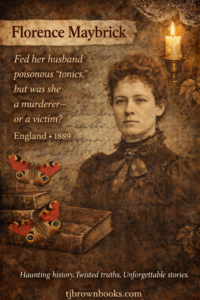
This is perhaps the most interesting—and juiciest—entry in my murderous women series. Florence MayBrick was an eighteen-year-old American girl who married an Englishman, James Maybrick, many years her senior. At first, the couple seemed happy, despite their twenty-three–year age difference, and were the toast of Liverpool, regularly seen at the most important balls and social events. Soon, however, cracks began to emerge.
It turns out James had a penchant for both extramarital affairs and hypochondria, taking a large assortment of the most popular tonics and medicines of the day—many of which contained arsenic and other toxic chemicals. Young Florence was no saint either and carried on a number of affairs herself, including one with Maybrick’s own brother. After one particularly violent argument, James told Florence he intended to divorce her.
Florence allegedly responded by giving him a double dose of strychnine.
She then sent compromising letters to her current lover, which were intercepted by a nanny who hated her and passed along to Maybrick’s brother. Those letters were then given to yet another brother—the head of the family. (See? I told you it was juicy!)
James was treated several times for dyspepsia but continued to worsen. After his death, his suspicious brothers had his body examined and traces of arsenic were found. Soon after, Florence was arrested for his murder.
Victorian England was scandalized when she was sentenced to death, as the prosecution’s evidence didn’t seem to hold up. Many men took arsenic as an aphrodisiac, and a chemist testified that he had sold it to Maybrick regularly. Following a public outcry from those who believed Florence innocent, the judge commuted her sentence to life in prison.
Florence was released fourteen years later and returned to the United States, where she penned a memoir titled Mrs. Maybrick’s Own Story: My Fifteen Lost Years. She spent time on the lecture circuit advocating for prison reform and proclaiming her innocence, but ultimately died alone and penniless in 1941.
So tell me, was Florence Maybrick a calculating poisoner—or a victim of a time when women were punished for stepping outside the norm?
If you enjoy my blogs and want to read more you can sign up for my very infrequent newsletter here.
If you want to preorder my Lizzie Borden, Fall River, you can do so here.
Recent Comments