
BLOG
The Lizzie Borden Collection
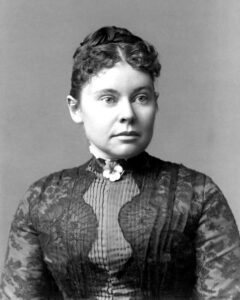
As you can imagine, I did a deep dive into the Borden murders, even though much of the story takes place when Lizzie was eighteen. Clara, orphaned at fifteen, was sent to live with the Bordens for the summer before she is to be shuffled off to a fancy boarding school by her extensive, well to do and well-connected family. She and Lizzie spend time walking around Fall River and in order to get the setting as accurate as possible, I had did quite a bit of research on the city during the mid-Victorian era. The Fall River Historical Society was instrumental and through them I bought the biggest book I have ever seen on the history of Fall River. You can check them out here for all things Lizzie.
In addition to pouring over old court documents, I studied train derailments of the 1800’s, explored the gold rush in the Blue Mountains, and poked around old museums in Baker City, Oregon. I also discovered that the University of Michigan was the first to offer co-educational medical studies. All of those things made it into the book.
Then there were the newspaper archives. The Library of Congress is a treasure trove of Lizzie Borden stuff. You can check it out here. Here is another good newspaper source at Crime Archives.
And honestly, this is what gave me the idea for Fall River in the first place: Lizzie the Musical.
One of the most notorious crimes in US history set to punk music with an all female cast? Sign me up!

Interested in more? Pre-order Fall River here!
Clara, the Real Main Character of Fall River

Though Lizzie Born is one of the main characters of Fall River, she isn’t the only one. Author, Cat Winters, said this:
I wasn’t sure if a fictional cousin of Lizzie Borden’s would stand out compared to Lizzie, but Clara was a complex, fascinating character, as was her relationship with Josiah. I’m so impressed!
That’s exactly what I was going for. Clara needed to be as psychologically complex as my depiction of Lizzy Borden and I think I hit the perfect note. Clara, for much of the story is traumatized. Traumatized by her parents death at the age of fifteen, traumatized by her summer in the Borden household and traumatized again by her admittance into an insane asylum after her breakdown at the university.

This is what I imagine Clara to look like. Beautiful, remote and underneath it all, furious.
Actor Natalie Dormer nails it.
For a large portion of the novel, Clara is reacting to her abuse and her circumstances, allowing the past to dictate much of her actions, but like all the best character arcs, growth, no matter how painful, is a necessary part of her journey. Spoiler alert: It ends well, but she has to earn it.
You can read the first chapter here.
You can order the book (either digitally or the paperback), here.
And finally you can sign up for my newsletter here.
Fall River Chapter One!
For your reading pleasure and my absolute terror, I offer you the first chapter of Fall River! And don’t forget to sign up for my newsletter and pre-order the book. Links at the bottom!
Ignoring the nagging ache of her lower back, Clara Lodge hunched over her desk, trying to transcribe Josiah’s illegible notes into something readable.
The late afternoon sun splashed in through the narrow windows of the back room, highlighting the dust motes swirling like ghostly apparitions in the air. She knew she should clean, but most of Josiah’s patients—miners, ranch hands and the occasional prostitute—didn’t really care. Which was good because she’d never been much of a housekeeper.
A memory, unbidden and unwanted, flashed through her mind, and Clara shivered in spite of the dry heat that turned the room into an oven.
“He expects us to be unpaid maids,” her cousin had whispered of her father the first night they met, and Clara recalled how her voice, oddly devoid of emotion, had scuttled down her spine like a rodent.
Fourteen years and the thought of her cousin still twisted her stomach into knots. She turned back to her lover’s atrocious handwriting, struggling to keep the memories at bay—memories so dreadful that even Josiah, who’d had the blood of soldiers spill over his hands, winced the few times she’d mentioned them.
Clara shook her head, impatient with herself. “Did you prescribe Mrs. Silverman soothing drops or sooty hops?” she called through the open door to Josiah, who was still puttering about in the front clinic.
The tension across her shoulders eased at the sound of his laughter.
“The drops, though hops would probably be just as helpful. Her nervous troubles stem more from taking care of eight boys while her husband is in the mines than by anything physiological.”
Josiah continued his cleaning, and she listened to the comforting sound of his whistling as her best friend and lover moved about the clinic. He’d been her hero for most of the past fifteen years, ever since he found her broken and raving in a New Bedford alleyway. What would she have done without him?
Ended her days in an insane asylum, probably.
“I’m a Yankee Doodle Dandy, a Yankee Doodle do or die…”
The terrible whistling turned into terrible singing and her smile deepened.
Most of their afternoons were spent this way—Josiah cleaning while she finished up the paperwork. Because both were haunted by their pasts, they found the predictability of a routine a comfort. Josiah’s ghosts were rooted in the Indian wars while hers were best not spoken of. Clara knew that he was in love with her—just as he knew that her ghosts left her unfit for love.
The singing stopped and her pen paused as she waited for it to begin again.
“There’s a crowd down by the Herald,” Josiah said from the front room. “I think the newspapers came in. I’m going to go grab one before they’re gone.”
“Alright. Hurry back with it.”
It took time for big city news to travel from Boise or Portland to Baker City. The Baker City Herald did a respectable job of publishing important news items from back east, but new reading material was always welcome and more exciting than a church revival.
After putting the notes away, Clara opened the back door to see if Mother Nature had decided to bless them with a breeze. She usually didn’t in August, but one could hope.
When Josiah and Clara first moved to Baker City, they bought the wide lot on the corner of Valley Avenue and Resort Street, as much for the grove of birch trees that grew on it as its proximity to the makeshift hospital where Josiah worked. They’d designed the brick building so the clinic and office faced the street and the living area in the back opened up to the Powder River, though goodness only knew how long that would last. Baker City was enjoying its second gold rush, and the industrious sound of hammers and saws punctuated the afternoon. Every trip to Geddes and Pollman’s butcher shop or People’s Grocery and Glassware showed new buildings being erected as quickly as bricks could be formed and fired. She wouldn’t be surprised if she woke up one morning to find a three-story frame house blocking her view of the Elkhorn Mountains.
Idly, she watched a boy in a battered straw hat drive a pig down the trail next to the river. Occasionally, the young herdsman would give the pig a halfhearted thwack across the backside, and in response, the animal would jog a few dusty steps before settling back into a heat-induced slog.
On the back corner of their property a squat, stone building with a slanted timbered roof and thick wood door partially obscured her view of the river. More shed than house, the building was only about ten by twelve feet but did boast one small window next to the door, which gave it the look of a one-eyed sailor. She loved that building even more than she did the shiny new house or the view. Josiah had fitted it out with an icebox, shelves, a worktable, and her microscopes. She’d christened the building her laboratory and the word rolled off her tongue with all the intoxicating juiciness of a watermelon that had been left in the river to chill. Technically, she was a nurse, but she would always be a researcher at heart.
Across the fields, Mrs. Stevenson rang the supper bell for her eight boys, and down the street, music spilled out of one of the saloons where miners and cowboys were settling in for a slow night of drinking.
For a moment, Clara was tempted to allow herself to sink into the contentment that snuck up on her increasingly more often. The effervescent feeling that, if she would just allow it, she might actually be happy. The sentiment was always followed up with a nagging uneasiness that permitting such folly would only expedite the dropping of the other shoe— the shoe that would ruin everything. Most likely a dirty old miner’s boot, she thought sourly. Superstitious, she squashed happy feelings as soon as they appeared.
As if on cue, the mournful sound of a train rose above the sound of construction, and Clara’s hands clenched to keep them from clapping over her ears. As it did almost every day, the train was coming down from McEwen, hauling men, timber and gold.
She’d never get used to that sound. If Josiah were here, he would rub her neck until the whistle faded, his gentle fingers calming her anxiety.
Trains had defined Clara’s world—from her unexpected birth on the Pennsylvania Express, to leisurely trips up and down the Eastern Seaboard on her parents’ speaking tours, to the final journey that took her parents’ life in the bloodiest train wreck in US history.
Drawing in a deep breath, Clara stepped back into the house, wincing as another whistle rang out. She should start supper, but it was still too hot to light the stove. Maybe Josiah would be happy with bread and leftover beans from dinner. Or maybe he’d take her to eat at the Grand Hotel. Let someone else sweat over a stove.
But where was he?
Perhaps he stopped at the hospital to check on a patient on his way home. She’d strangle him if he made a side trip to Joe’s Saloon to read and discuss the news with the miners before bringing it to her.
As if she’d conjured him, Josiah stepped through the doorway. She turned to him, smiling. “It’s about time.”
Her smile faded as she caught sight of his kind, homely face, as pale as death.
An unnamed fear tightened her chest. “What is it? What’s wrong?”
“Lizzie,” he whispered.
The name slithered through the room like a serpent, and Clara gripped the sides of her desk to keep her legs from buckling.
“What is it?” she asked with increasing urgency, even though, instinctively, Clara knew that his next words would blow up the life they’d carefully built over two thousand miles away from Fall River. In her mind’s eye she saw a shoe wildly spinning through the air on its journey to the floor.
“She’s been accused of murdering her parents. With an axe.”
Josiah caught her moments before she hit the ground and gently settled her in her chair. Her hand clutched his sleeve as she sought the safety of his eyes. His gaze reflected the sickness that pierced all the way to her heart.
Though neither of them said it aloud, she knew they were both thinking of the jagged scars that ran from Clara’s shoulders to her lower back.
Scars she’d received at the hand of her cousin, Lizzie Borden.
On Being a Hybrid Author: Liberation and Loneliness

Fall River comes out in less than a month. The gothic, literary, historical story that has taken up space in my head for the better part of eight years is finally, at long last, being birthed in a completely unexpected way. (And no, it usually doesn’t take me that long to write a book, but between my first draft and the last one, I moved three hundred miles from the home I’d lived in for thirty years, started a new career, wrote another book and got my degree, so…) To keep the baby metaphor going, it’s like when you plan on a home water birth and end up having an emergency c-section. You’ve had a half a dozen or more home water births and are a pro, but a c-section is a whole different animal and the learning curve is STEEP. You can’t really prep for it because you don’t know what you don’t know. Ultimately, you end up with the same baby, just by a different method.
The thing is, I haven’t been this terrified since my first novel, Read My Lips came out in 2008. Because I had lots of professionals invested in the success of my little YA about a deaf girl, i had lots of help. Editors, copy editors, designers, and a whole marketing team, (though in reality it was probably and intern). I felt supported and the potential ramifications of y ignorance of the process was muted because of that support. By my third and fourth books, I felt like a pro. Professional enough to know when someone on the team had dropped the ball.
Now it’s me. I am the one juggling all the balls. It is both liberating and very, very lonely.
I am the one making the decisions. I thought it would be cool to do a blog tour with the same marketing people who did my Born of Illusion books. In a kind of where are all my now grown YA readers now kind of way. Would they like my adult book? I won’t know because my decision making capabilities have been slowed by ALL THE DECISIONS I HAVE TO MAKE. Like, should I use this newsletter program or that one? Which marketing professional should I use? What kind of advertising and where? Do I like this website template or that one? How on earth do I use -fill in the blank- program? Paralyzed, I missed the blog tour window.
And, since I am being so honest here, I am absolutely terrified that you all won’t like my book. So on top of my fear of botching social media and not finding my readers, I have the age old author fear that the book just sucks and not even Harper Collins’ best and brightest could fix it.
But…
In addition to the anxiety I have over the whole process, there is a certain, liberating joy that comes from owning the whole process. Yes, when I make mistakes, I only have myself to blame, but when I figure something out, when I see the final cover, when I batch a weeks worth of social media or come up with a good idea, the pride in myself is palpable. I am creating. I am making something from nothing and let me tell you, that is SO MUCH better than merely consuming. I am also paying other creators to help me, other female entrepreneurs which means so much to me. With my choices, as uneasy as I am about making the wrong one, I am building my own community of creators. I think that web is something that indie-published authors often forget.
it hit me today that i love being an indie author. I love owning my own little publishing country and I love having an agent and being on submission at the big five. I don’t have to be one or the other. i can do both.
And I am.
Don’t forget you can sign up for my newsletter here (I am figuring it out!)
You can pre-order Fall River Here
And you can see my other trad published works here and here.
When People Around You Keep Dying…
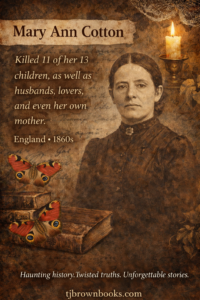 Mary Ann Cotton, an English woman who lived during the Mid 1800’s in County Durham, had a habit of marrying men and then collecting the insurance policy when they died.
Which they invariably did.
At 20, Mary Ann married her first husband, collier laborer, William Mowbry. Of the five children she bore him, four of them died and none of their deaths were registered as per British law. She bore four more but they passed of gastrointestinal issues. William also died from the same malady. Mary Ann collected insurance on all of them.
After William passed, Mary Ann and her surviving child, Isabella, moved to another part of the country where she met and married a sickly gentleman, George Ward. She sent Isabella to live with her mother and soon after, George died of cholera. Though George was never very well, the doctor on the case was surprised by his sudden passing. Perhaps Mary Ann was also surprised… or perhaps not as she also collected the insurance benefit for poor, invalid, George.
Her third husband, James Robinson turned to Mary Ann, (his housekeeper), after his wife died and she became pregnant. During this time, Mary Ann’s mother came down with hepatitis and Mary Ann went to nurse her back to health, though, perhaps that’s a stretch, as soon as her mother recovered from hepatitis, she came down with a mysterious stomach ailment that killed her. Back to James Mary Ann went, along with Isabella and the two were married. Unfortunately, James’ children all died at the same time as her daughter, Isabella. Luckily, Isabella was insured and Mary Ann was able to collect on her. They had a son, George. Soon James became suspicious when Mary Ann began to insist that he take out life insurance. When he discovered that she had run up debt behind his back and was having their son pawn the family valuables, he threw her out and retained custody of George, probably saving both their lives.
Desperate and homeless, Mary Ann turned to her friend, Margaret who introduced her to her brother, Frederick Cotton, who had recently lost his wife. Margaret was raising her nieces and nephews for her brother, but she soon passed from an indeterminate stomach issue and Mary Ann was there to comfort the bereaved Frederick, who as you may have guessed, soon passed away from gastric issues, leaving Mary Ann with the insurance money.
But wait, there’s more.
Mary Ann took on two lovers and one of them died after changing his will, leaving Mary Ann with everything. One of the Cotton boys was still with her and she tried to get a parish official to put him in a workhouse. He died five days after the attempt failed and the official went to the police to have them investigate. The local newspaper latched on to the story and soon discovered that Mary Ann had lost four husbands, 11 children, her mother and a lover. Mary Ann was soon arrested, but the trial was delayed because Mary Ann was pregnant. The lucky child was taken away soon after birth, Mary Ann was found guilty of one murder, though suspected of many more.
She was put to death on March 24th 1873.
Britians first female serial killer was immortalized in this film, Dark Angel. You can read more about her here.
https://en.wikipedia.org/wiki/Dark_Angel_(British_TV_series)
https://www.britannica.com/biography/Mary-Ann-Cotton
Florence Maybrick: Murderer or Misunderstood?
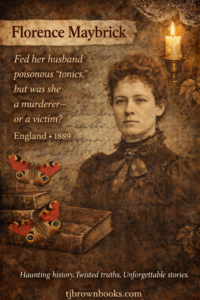
This is perhaps the most interesting—and juiciest—entry in my murderous women series. Florence MayBrick was an eighteen-year-old American girl who married an Englishman, James Maybrick, many years her senior. At first, the couple seemed happy, despite their twenty-three–year age difference, and were the toast of Liverpool, regularly seen at the most important balls and social events. Soon, however, cracks began to emerge.
It turns out James had a penchant for both extramarital affairs and hypochondria, taking a large assortment of the most popular tonics and medicines of the day—many of which contained arsenic and other toxic chemicals. Young Florence was no saint either and carried on a number of affairs herself, including one with Maybrick’s own brother. After one particularly violent argument, James told Florence he intended to divorce her.
Florence allegedly responded by giving him a double dose of strychnine.
She then sent compromising letters to her current lover, which were intercepted by a nanny who hated her and passed along to Maybrick’s brother. Those letters were then given to yet another brother—the head of the family. (See? I told you it was juicy!)
James was treated several times for dyspepsia but continued to worsen. After his death, his suspicious brothers had his body examined and traces of arsenic were found. Soon after, Florence was arrested for his murder.
Victorian England was scandalized when she was sentenced to death, as the prosecution’s evidence didn’t seem to hold up. Many men took arsenic as an aphrodisiac, and a chemist testified that he had sold it to Maybrick regularly. Following a public outcry from those who believed Florence innocent, the judge commuted her sentence to life in prison.
Florence was released fourteen years later and returned to the United States, where she penned a memoir titled Mrs. Maybrick’s Own Story: My Fifteen Lost Years. She spent time on the lecture circuit advocating for prison reform and proclaiming her innocence, but ultimately died alone and penniless in 1941.
So tell me, was Florence Maybrick a calculating poisoner—or a victim of a time when women were punished for stepping outside the norm?
If you enjoy my blogs and want to read more you can sign up for my very infrequent newsletter here.
If you want to preorder my Lizzie Borden, Fall River, you can do so here.
When You Like Money But Detest Men-Dating Advice Belle Gunness Style
Welcome to part two of my weird, creepy series called Five Women Who Should be as Notorious as Lizzie Borden. This one is a doozy and I’m shocked that I had never heard of Belle Gunness, a woman arguably considered one of the most prolific female serial killers of all time.
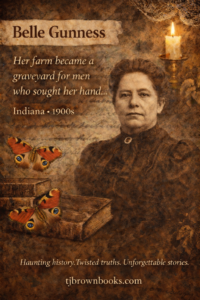
A Norwegian native, Belle moved to the United States in 1981 at the age of 22. Like many Norwegians of that period, she ended up in the Midwest. A strong believer in insurance policies, Belle had two taken out on both her first two children, who both died of intestine infections and two taken out on her husband who died of a brain hemorrhage. With the payouts, she bought a pig farm in LaPorte, Indiana. (She was a big, strong woman with deep agricultural roots.)
She remarried and after her husband skull was crushed by a meat grinder, (he was reaching up on a shelf to get something down and the meat-grinder fell on his head. TOTAL ACCIDENT, I’m sure), Belle collected $3000 from insurance.
Anyhoooooo, Belle must have discovered that she liked money but disliked men because she started placing adds in newspapers searching for a husband. Belle would correspond with each potential suiter, no doubt to discern how well to do they were. They were then instructed to come to her farm with their money and tell no one. (Like that’s not suspicious? No alarm bells, guys?)
The crazy thing is… THEY DID. *blinks rapidly*
After a fire burned the Gunness farm to the ground, inspectors found the remains of a headless women, they assumed to be Belle, as well as the remains of her three children. Upon further inspection, the inspectors found so many bodies buried around the farm that they lost count. Her on again off again lover and farm hand confessed that he had burned the house with the children in it as instructed by Belle. The headless women was actually a murder victim.
Wait, what?
The farm became a tourist attraction where you could buy souvenirs because people are apparently weird and macabre, and several movies and songs were written about her. So definitely almost as notorious than Lizzie Borden and honestly sort of makes Lizzie’s alleged crime seem like nothing.
If you like the series, you can sign up for my newsletter here or you can preorder my Lizzie Bordenesque book, here.
More on the Gunness Murders
Link
Dealing with a Cranky Boss, Kate Webster Style…
Welcome to the start of a new blog series that was so much fun to research and write. And by fun, I mean I discovered things that totally creeped me out and kept me up at night. See, fun! And don’t get me wrong, As much as I love scary books, I do NOT like scary movies and refuse to watch them. But books that make my skin crawl? Now that’s my jam. I love both reading and writing them.
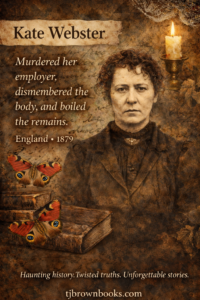
First women who deserves to be as notorious as Lizzie Borden is Kate Webster, a cheeky lass who hated her employer so much she killed her, dismembered her and boiled her before tossing the rest of the poor women in a trunk and ditching it in the River Thames.
Thirty-year-old Kate had a history of moving from job to prison to job. Her victim, 54-Year-old Julia Martha Thomas, was a twice widowed former schoolteacher, who was very invested in being viewed as posh as possible. To enhance that image (and get out of doing the dishes?) she hired live in help, but had trouble keeping them because she was notoriously exacting and mean spirited. (I wonder what kind of teacher she was?!!!) Most of her maids simply left, but not Kate Webster. After one particularly heated argument, Kate threw Julia down the stairs and then choked her to death to keep her from causing her any more trouble. Of course, Kate then had the problem of the body. But our Kate was a real problem solver, as is evidence by this quote from her eventual confession:
“I determined to do away with the body as best I could. I chopped the head from the body with the assistance of a razor which I used to cut through the flesh afterwards. I also used the meat saw and the carving knife to cut the body up with. I prepared the copper with water to boil the body to prevent identity; and as soon as I had succeeded in cutting it up I placed it in the copper and boiled it. I opened the stomach with the carving knife, and burned up as much of the parts as I could.”
Unable to burn or boil everything, she ended up stuffing as much as she could into a bag. The head and a foot didn’t fit so she simply tossed the foot into a garbage in Twickenham and buried the head in a garden which wasn’t discovered until 131 years later! (In Sir David Attenborough’s garden, no less!) Kate posed as Julia for two weeks while she was trying to dispose of the body, but neighbors became suspicious and Kate fled to Liverpool. When the police finally arrived at Julia’s cottage, they discover blood stains, finger bones and fatty deposits in the kitchen. Clearly, Julia had a point when chastising Kate about her cleanliness and a maid that doesn’t clean, is no maid at all…
Victorian England was as scandalized as it was titillated by the crime and the trial. At any rate, after a grisly and well publicized trial, Kate Webster was put to death for her crime.
Please take a moment to sign up for my newsletter for more uplifting stories like this one, or pre-order my book, Fall River.
More information about the Kate Webster murder:
My 2025 Reading List
It was hard for me to make out this list of my favorite books of 2025. Not because I read so many but because this is the sum total of all the fiction I managed to read last year. I did read about five or six non fiction books, but as a life long reader, this list is pathetic, not in content, of course, but in volume!
Of course, to give myself a break, I was reading a lot for school, working on my writing and working a full time job, however, I still believe that the slim four or five inch device that is always on hand, also has a lot to do with. I plan on changing that this year!
Without further ado, my list! (Please keep in mind that I am not a book reviewer and if I never have to analyze another book under the dictates of Literary Criticism, it will be too soon!)
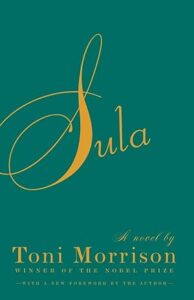
Sula by Toni Morrison
This one was so powerful and insightful and of course, reading Morrison’s writing is like a master class in tightly woven plotting and characterization.
Remote Control by Nnedi Okorafor
This strange little book blew my mind. Deeply odd and beautifully written, this book was absolutely heartbreaking and strangely empowering.
Future Home of the Living God by Louise Erdrich
Another beautifully written book that I actually listened to while traveling. Part science fiction, part environmental catastrophe and all gorgeous… except the end. I wanted a happy ending so bad!
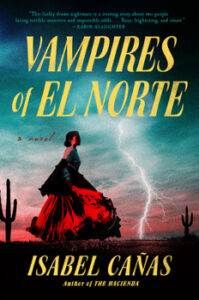
Vampires of El Norte by Isabel Canas
Absolutely stunning and everything I love in a book-scary, inventive, historical and wildly romantic. This may be my favorite new book of the year.
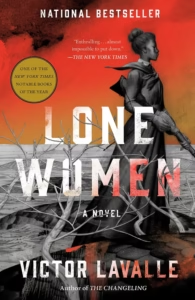
Lone Women by Victor Lavalle
Another scary one, also brilliant. Historical Horror on the Western Plains. I loved this book. It also makes me happy that maybe western horror is a thing because Fall River definitely has that vibe.
The House on Mango Street by Sandra Cisneros
Sweet, nostalgic and sad. I can understand why this was an instant classic.
A Tree Grows in Brooklyn by Betty Smith
Speaking of classics… I re-read this one every few years because I just love everything about it. I care not about the head hopping or the minor inaccuracies. Francie will always be my girl.
Seven Questions Authors Should Ask Themselves Before Making their 2026 Writing Goals

As I look ahead to 2026, I reflect on my intentions of past—what worked and what didn’t? it’s from that place of reflection that I craft my writing goals for the next year. Here are seven questions authors should ask themselves before making those writing goals.
1. What is your reason for writing?
Ask yourself, “what is my why? Your why is the foundation. It’ll sustain you through rejections, poor sales, sudden successes and those creatively dry periods. My why is what keeps me going through the good times and the bad times—through the six figure deals, the trips to NYC, getting dumped by my agent, the disappointment. I have been an author for years and as I look ahead to my new chapter, I have to keep my why at the forefront of my mind.
2. Is this a practical goal or a delusional goal?
It’s okay to have both. In fact, it’s preferable to have both! Practical goals are “safe”. They keep you grounded in a consistent, workhorse kind of way. They feel good. Attainable.
Delusional goals are exciting, risky and emotionally uplifting. When you daydream about your delusional goals, don’t think, “I’ll never achieve that.” Instead, think, “Wouldn’t it be so fun if XYZ happened?” The energy is completely different and, well, energizing! Consider astronauts—only form a place of safety, (science backed technology), were they able to reach for the stars.
The key is to create both practical and delusional goals.
3. How will you make sitting down to write FEEL good?
Writing is hard, people. Sometimes I am excited to sit with my hands on the key board, creating words, sentences and stories. Other times, I’d rather have wisdom teeth extracted. So it’s important for me to romanticize my writing time. How I do this depends on the book , how much I need to write, and even the time of day. The goal is to shift my energy into excitement and expectation. When I wrote Born of Illusion, I played a lot of 1920’s era jazz. For my Lizzy Borden book, Fall River, I liked the room to be candle lit, and darker classical music softly in the background. The point is to consider how you are going to make writing fun even on those days when it doesn’t feel fun.
4. Are your goals you dependent?
Make sure your goals are dependent on you, not anyone else. I once made the mistake of making one of my goals to score a publishing deal. At the end of the year, I realized my error. It was a goal that neither myself nor my agent had any control over. We both worked as hard as we could, but we couldn’t control the market or the industry. Financial goals are similar. Not that I don’t make them, but they are similarly risky because we can’t control sales or the economy.
5. How are you going to refill the well?
In Julia Cameron’s book, The Artists Way, she writes extensively about a concept called the artist’s date. Do something that inspires creativity. This can be as simple as walking in the woods or heading to a coffee shop with a cool, creative vibe to fill up on caffeine and people watch. Or it might be as involved as heading to the museum or experiencing something new. For me, doing something completely out of the ordinary energizes me. I have gone to a sound bath and soaked in a float tank just to fill that creative well.
6. What are your challenges and strengths?
Do you struggle with time management? Then maybe a daily word count isn’t the goal for you. And honestly, daily goals/habits are the most difficult to reach because they take a level of consistency that most of us can’t maintain. Then we have to deal with the sense of failure when we miss a day and it’s incredibly hard to get back on track. In this case if you start with a large goal, say a weekly word count, you are building flexibility into the goal. Maybe you are awesome at time management but have a serious inner editor problem that makes moving forward difficult. In that case, it may help to set a time and see how many words you can write in five minutes or so. Having an awareness of your strengths and challenges will help you create goals that build on your assets, as well as give you opportunities to strengthen the areas you struggle with.
7. What will make this a successful writing year even if nothing “big” happens?
Before the year begins, define what success actually looks like for you, separate from validation, sales, or industry milestones. Is it finishing a draft? Returning to the page after burnout? Rebuilding trust in your voice? Falling back in love with storytelling? If the year ends without a book deal, a viral moment, or a bestseller list—what would still make you proud of how you showed up as a writer? When you define success on your own terms, you give yourself something powerful: a way to win no matter what the industry does. And those quiet wins—the finished pages, the consistency, the courage to keep going—are often what lead to the “big” moments anyway.
You can find me on Facebook, Twitter, and Good Reads.
You can also try to get in touch with me telepathically.
That would be pretty cool.
If that fails, you can email me or use the form below:
Teri Brown Books | Site Content Copyright © 2026 All Rights Reserved
Recent Comments