
BLOG
Guest Post: Depression Sucks by Author Heather Brewer
When I started this series on writers and mental health, I added a million disclaimers. What I wanted was a series of posts on strategies to help authors protect their own mental health–I didn’t want anyone to think I had a fix for those who suffer from serious depression. The things I wrote about: meditation, healthy diet, journaling & exercise, are just strategies. But I also wanted to address serious depression, and I envisioned this amazing and fabulous post by my friend and fellow author, Heather Brewer, because:
- She’s an amazeballs writer.
- She’s incredibly compassionate.
- She battles serious depression.
It’s even more awesome than I thought it would be.

Depression Sucks
TRIGGER WARNING: The following blog post is about depression, suicide, self-harm, anxiety, and all sorts of unpleasantness. If you feel you may be triggered by these things, please don’t read it. And remember—Auntie Heather loves you.
Depression sucks.
Can I just put that out there? It sucks and it often feels like there is no end to it at all and the worst part is that no one wants to talk about it. So those who suffer from it feel isolated and weird, which only manages to feed the beast. The beast grows bigger, until it’s the only thing in the world that someone who suffers from it can see. It’s ugly and horrible and feels so damn inescapable.
I know. I have depression. I also have Obsessive Compulsive Disorder and anxiety. I suffer from bouts of suicidal tendencies. I attempted suicide when I was sixteen. Tried to hang myself in a closet. The bar broke, and until recent years, I never told anyone about it. But I’m becoming more vocal about such things now. Mostly because I noticed that no one wants to talk about it.
That makes me angry, if you want to know the truth. So many of us are suffering from mental health issues, but there’s still such a stigma attached to it. I want to change that, if I can. Even in a small way. If you watch my vlogs or follow me on social media, you’ve probably heard me talk quite openly about my mental health. When I do so, I notice that a lot of people get quiet. Maybe they don’t like the squicky way the subject makes them feel. Maybe they don’t know what to say or how to help. Maybe they have these issues too and aren’t ready to talk about them. Maybe they just wish I’d shut up.
But I won’t shut up. Because I am not ashamed. After all, I have nothing to be ashamed of.
I have, for as long as I can remember, had these issues. I see the anxiety in my daughter already—apparently I gave her that little gem of DNA to deal with for the rest of her life (sorry, kid). But no one ever told me, throughout my childhood, throughout my teen years, throughout much of my adulthood, that having mental health issues doesn’t mean there’s anything wrong with you. It just means that you have health issues that you need to manage. For me, that means therapy, meditation, and medication. For you, it might mean something different. But it begins with coming out of the mental health closet and saying, even to yourself, “This is how I am, and it’s okay—I can get help.”
Recent years have been a major challenge for me. I self-harmed, planned out a suicide attempt, and said goodbye to the world. But then something funny happened. I got sick with severe anemia and stuck in the hospital for days. (Okay, maybe not funny ha-ha) But the thing is, lying in that hospital bed gave me a lot of time to think. I didn’t think I wanted to live. But what I did think was a question.
“Have I really tried everything possible to make myself better?”
The answer was no. I had not yet tried medication. So I made myself a promise and gave medication a go. So far, the meds are working. Every day is not sunshine and rainbows. And some days, yes, I still have dark thoughts, and wonder if I can bear to keep going. But the answer is yes. I can. Because of you, Minions. I can’t leave you alone to face the darkness. I won’t.
So when you’re there, in that dark place, and you feel like you’re all alone…just reach out and give my hand a squeeze. Because I’m here. And we’ll get through it.
Together.
RESOURCES:
• The American Psychological Association (www.apa.org)
• The American Association of Child and Adolescent Psychiatry (www.aacap.org)
• National Suicide Prevention Lifeline 1-800-273-TALK (www.suicidepreventionlifeline.org)
The National Suicide Prevention Lifeline’s mission is to provide immediate assistance to individuals in suicidal crisis by connecting them to the nearest available suicide prevention and mental health service provider through a toll-free telephone number: 1-800-273-TALK (8255).
VELVET UNDERCOVER
I love all my covers, but this might just be the loveliest one yet! Observe the pretty! 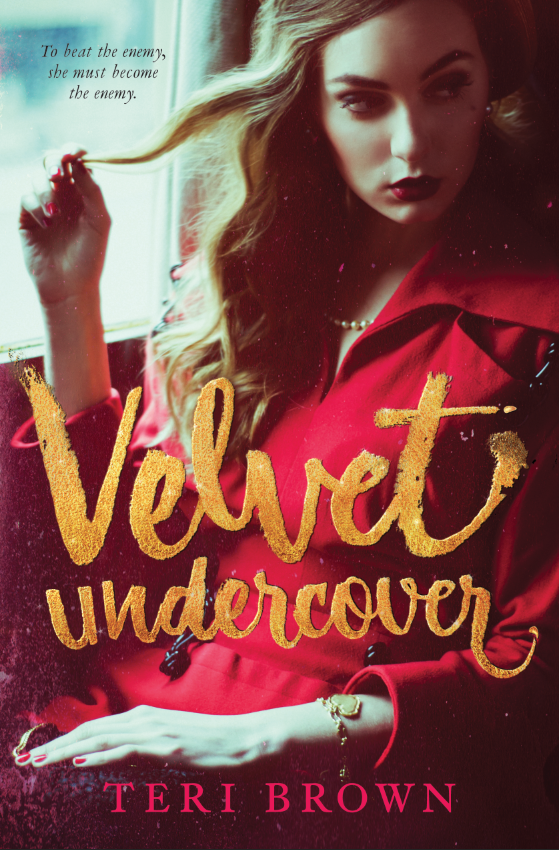
Samantha Donaldson’s family has always done its duty for the British Crown. In the midst of World War I, seventeen-year-old Sam follows in their footsteps, serving her country from the homefront as a Girl Guide and messenger for the intelligence organization MI5. After her father disappears on a diplomatic mission, she continues their studies of languages, high-level mathematics, and complex puzzles and codes, hoping to make him proud.
When Sam is asked to join the famed women’s spy group La Dame Blanche she’s torn—this could be the adventure she’s dreamed of, but how can she abandon her mother, who has already lost a husband to the war? But when her handlers reveal shocking news, Sam realizes there’s no way she can refuse the exciting and dangerous opportunity.
Her acceptance leads her straight into the heart of enemy territory on a mission to extract the most valuable British spy embedded in Germany, known to the members of LDB only as Velvet. Deep undercover within the court of Kaiser Wilhelm II, Samantha must navigate the labyrinthine palace and its many glamorous—and secretive—residents to complete her assignment. To make matters worse she finds herself forming a forbidden attraction to the enemy-a dangerously handsome German guard. In a place where personal politics are treacherously entangled in wartime policy, can Samantha discover the truth and find Velvet before it’s too late…for them both?
From author Teri Brown comes the thrilling story of one girl’s journey into a deadly world of spycraft and betrayal—with unforgettable consequences.
Keep Calm and Go Om?
I arrived late at the meditation party. Born in the sixties and raised in the seventies and eighties, many of my friends and relatives had jumped on the bandwagon way before I did. Transcendental Meditation, Buddhism, Hinduism, stonedism… even though I always had hippie tendencies, it still was just a bit too “floaty” for me.
Then I discovered Headspace and everything changed. Headspace advocates meditation that had nothing to do with religion or spirituality and everything to do with mental and physical health. Along with this video by news anchor Dan Harris, Headspace made meditation something real and attainable by actual people as opposed to gurus. It showed me that there is science behind the assertion that meditation is seriously good for you. On this page, Headspace shows many different areas that meditation is good for your mental health.
I could put together a technical blog outlining some of the research that explains exactly what scientists are finding, but it’s probably way about my head. I know because I tried. There were words being thrown about like neuroplasticity, cognitive control and amygdala. But basically, it’s like this: When we practice mindful meditation, it physically changes our brain and has a number of positive outcomes. One study found that meditation helps increase the brains ability to pay attention… according to the study a “wandering mind” is indicative of lower levels of happiness. Individuals with an increased ability to “live in the moment” instead of regretting the past or worrying about the future are over all happier. Meditation helps with that.
Another article on Forbes that suggests that meditation may actually rival medications in treating depression…without the side effects.
I’m a total believer. I feel as if meditation has increased both my focus and my creativity. I take twenty minutes out of my morning to meditate and I feel the effects for the rest of the day. By being able to focus more fully on each task, I not only accomplish more but I enjoy it a lot more, as well.
And that, is a very, very good thing.
Write Your Way Happy?
 The last thing any writer wants to hear when they already put in thousands of words a week is to write more, but that is exactly what new studies are suggesting. Writing down your feelings can actually improve mood.
So maybe those angst filled chronicles of our teen years really helped.
A recent article on the New York Times website suggests that writing your personal stories can improve, not only mood, but outcomes. Research done on college students who were stressed about grades and worried that they weren’t smart enough for school were challenged to create an essay or video about college life to be seen by future students. The study found that grades and outcomes improved.
Another study asked couples with marital issues to write about the problems as an objective observer. Over time the couples participating in the study reported an increase in marital satisfaction.
Researchers believe that writing interventions can change people’s negative perceptions into more positive ones. James Pennebaker is a psychology professor and researcher at the University of Texas. He had college students write for 15 minutes a day about an important personal issue or superficial topics. Those who wrote about personal issues had fewer illnesses and visits to the student health center than those who wrote on superficial topics.
Journaling is a way to track your emotional responses to the events going on in your life. This can help on several levels:
- It gives people suffering from depression an easy way to move forward. One of the most insidious things about depression is that it saps motivation even to make the changes necessary to help yourself. Keeping a journal is easy, private and can be done at home in a short period of time.
- It tracks your emotions. Over time, journaling can help you see patterns in feelings and behavior, as well as show you improvements in both your life and your mental attitude.
- For writers, it can be a warm up—a way of expressing yourself that no one is going to judge. It can also help jumpstart your creativity.
Many writers advocate journaling daily, Natalie Goldberg, are Julia Cameron just two that come to mind. Though both have very different approaches, the results are the same, increased creativity.
During the periods of time when I journaled, I did see an increase in my productivity. Mood? Not sure. Sometimes I experienced a small sense of relief or catharsis, while other times I did it just to cross something off my daily list. The concept of changing your own story from something anxiety ridden and negative into something positive is intriguing. Sort of like the little engine that could idea. As the science behind this grows, I expect that we’ll learn much more about why and how writing improves mood and creativity.
Here are more articles on the subject of writing and mood.
http://www.webmd.com/depression/features/writing-your-way-out-of-depression
http://www.urmc.rochester.edu/encyclopedia/content.aspx?ContentTypeID=1&ContentID=4552
Exercise and the Pursuit of Life, Liberty and Happiness
We writers sit on our butts. A lot. Which isn’t good for our waist-lines or our mental health. Or, apparently, our lives. According to this article on CNN, sitting can actually decrease your life span which is pretty freaking alarming.
But I’m not going to address that today. I’m going to explore exercise and mental health. The links between anxiety, depression and exercise aren’t completely clear, but a number of studies have found that exercise, does indeed help ease symptoms caused by mental health problems.
This scholarly article on the National Library of Medicine website states that aerobic exercises has been proved to reduce anxiety and depression and the link is most probably caused by an exercise-induced increase in blood circulation to the brain which has something to do with the relationship between the pituitary gland, the limbic system, the amygdala and the hippocampus. Okay, so what they actually wrote in their study is far more technical, but the meaning is clear… get out of the chair and get some exercise.

According to these same good doctors, the health benefits from exercise include improved sleep, increased interest in sex, stress relief, improvement in mood, reduced tiredness which improves cognitive ability, and increased energy.
Insomnia, tiredness and lack of energy all make you feel sluggish, out of sorts and worsen mild depression or anxiety. I suffer from cyclic insomnia and can attest to its negative effects. Perhaps nothing has a worse effect on mood than chronic tiredness. It’s odd to think that exercise can increase both energy and alertness, but it does.
Another study by a team in England tested subjects suffering from mood disorders over a period of ten weeks. One group was given aerobic exercise, another relaxation exercises and another a music appreciation course. The patients were tested before and after the program with a psychological stress test. The subjects who spent ten weeks getting some sort of regular aerobic exercise showed the fasted recovery in both heart rate and electrodermal response to the same psychological stress. In other words, their recovery to stressors was much quicker than the participants who did the relaxation exercises and the music appreciation course.
This article in the New York Times is a fascinating look at how exercise changes our DNA. So basically, we are being changed at the molecular level just by making ourselves go to the gym. Wow.
I started running a little over a year ago and in spite of the time and energy it takes, I have been more energetic and productive than I’ve ever been in my entire life. Because of injuries, I’ve added strength training to my regular exercise routine and have the added bonus of increased strength. Currently I am working on adding yoga to my routine to increase my balance and flexibility. (Yes, I am prepping for old age where these elements are key!)
I feel like the lifestyle modifications I’ve made in my life over the last year, which also include diet and meditation, in addition to regular exercise, have been important in keeping me positive and focused. Finding exercise is like finding a new religion… it can be life-changing.
Photo credit: Mapichai and freedigitalphotos.net
The Mood/Food Connection
I’ve often wondered about the mind body connection. It’s well documented that chronic stress can have a negative effect on your body. But can your body, or more specifically, what you put in your body, have the same effect on your mind and mental health?

For years scientists have been skeptical that the food we nourish our bodies with can also impact on our moods and overall mental health. I’ve learned quite a bit lately about how food influences us and the complicated chemical reactions that occur within our physical selves on a regular basis. I’m not sure why scientists are so slow in accepting the healthy body/healthy mind connection because it seems like common sense to me. Certain foods trigger the release or production of chemicals such as dopamine and serotonin… both known to affect mood. (Here is a scholarly paper by Simon Young on how to increase serotonin in the brain without drugs. These strategies include exercise, light therapy and diet) Here is another interesting overview of serotonin by the Babbleout.
But the scientific community is finally catching up. It’ll only take several more million dollars’ worth of studies to come to the conclusion that our grandmother’s already knew—you are what you eat.
Did you know that low energy mimics depression and sugar crashes look very much like mood swings? Consider how much sugar the average American consumes. That in itself can affect our moods. The symptoms of a sugar or glucose crash include irritability, fatigue, confusion, anxiety, lethargy, difficulty concentrating—all things that people associate with mood disorders. You can read more about sugar in this piece by the Seattle Times. Some people are sensitive to wheat and the symptoms they experience can look very much like mood disorders. Food affects us. It just does.
I recently read this fascinating article in the Washington Post that tells of a study linking zinc deficiency with depression. The same article mentions research being done on a ketogenic diet helping to stabilize bi-polar disorder in some people. I found another study that connects a high fat diet with impaired brain function.
We’re just beginning to understand what is going on in our bodies on a molecular level and how that connects with mental health, but again, I believe its common sense to equate healthy eating to feeling better.
I know in my own life that when I’m making an effort to eat healthy, less processed foods, I do feel better. I have more energy and feel sharper. Is there a connection? Perhaps. But since eating healthy foods has a laundry list of positive benefits, I think it’s something every writer, (including those on deadline), should try.
Photo credit: Mapichai and freedigitalphotos.net
Fighting for Peace of Mind
As I swing into my mental health and your average writer month, I want to make a couple of disclaimers: I am not writing as a mental health professional. I’ll be writing on strategies to protect and promote your own mental health, not to regain it once it’s out of whack. HUGE distinction. If you have thoughts of harming yourself or others, please, please, speak to a professional.
What are my qualifications for writing on this subject, you ask? Well, I don’t have any, really. That’s why I’m going to be basically regurgitating information from experts who ARE qualified to write on mental health.
See how I did that?
If you have a propensity to gravitate toward the negative, toward anxiety, or the “blues”, there are well documented strategies to help you combat it. Again, I am NOT talking about people who are clinically depressed. I have family and friends who have combated this insidious disease and I wouldn’t pretend to know how to help them.
I do know, however, that no that no one is in charge of my own happiness except me. My husband can’t make me be happy. My children can’t make me be happy, and quite frankly, it isn’t their responsibility. They have their own battles to fight. The strategies I’m writing about are simply tools that help me in my own fight for happiness.
I can either immerse myself in the Ocean of Anxiety, the Sea of Drama, the Straits of Negativity, the Bay of Sadness or the Lake of Futility, or I can grab the oar and paddle like a wild maniac toward the shore. I have to want to be happy. No one can choose happiness for me. Life is hard. Sometimes it’s brutal. I can focus on that part of it, or I can focus on gratitude and acceptance while also working to change, in some small way, the parts of life that suck.
When my editor or agent criticizes something in my manuscript, I can choose to take it as a personal slight against me or I can take a couple of deep breaths and see it for what it is—advice to make the story better. When someone I love snaps at me, I can react to their words or I can take just a second to see where they are coming from—are they in a bad mood for some reason and venting on me? If so, should I allow their grumpiness impact my emotional barometer?
That’s what I mean by choices.
It’s also true that there are physical health issues that can severely impact mood. For example, PMS is a very real thing. Other hormonal and chemical imbalances caused by physical ailments can also produce mood disorders. A check up with your health care provider should be on your agenda if you find yourself suddenly swinging from sunny to dark and back again. (Either that or your on deadline. Then it’s perfectly normal!)
In the next few weeks, I’m going to be writing about certain strategies to help improve and protect your mental health and the science behind them. These include journaling, meditating, exercise, etc. I’ll also be documenting some of the studies that suggest that they can help those of us who wish to maintain mental health while also dealing with a host of characters talking in our heads.
And again, please see my disclaimer above if you are having thoughts of harming yourself or others, please get help. Please.
Writers and Mental Health
Is it just a myth that writers tend to be prone to fits of melancholia? (And yes, I’ve always wanted to write that in a sentence—fits of melancholia. Just lovely. So much more romantic a term than depression.)

The link between writers and depression, though still controversial, has been well documented. The question is, does writing make one prone to depression or are depressed persons more likely to become writers? I know that young women in the princess sports, (figure skating, gymnastics and ballet,) are more likely than the average person to develop eating disorders, but is that because the sport does it to them or is it because the very qualities needed to become successful in the sport—focus, discipline, drive and control—are the same traits present in many young women who develop eating disorders? Are the qualities that make a writer—the ability to spend large chunks of time in isolation, the tendency to live inside your own head, high levels of empathy—evident in many people prone to depression?
It’s sort of like the chicken or the egg thing.
In reality, it’s probably a bit of both. Writing can be lonely and isolating. Writers generally do possess high levels of empathy—it’s what helps create living breathing characters, after all. But empathy in a world filled with suffering can be overwhelming. Writing as a profession draws a lot of criticism and rejection. It’s rather like the fashion industry. Models go out on calls, put their looks on display and are told, “Nope, not what we’re looking for, you don’t get the job.” What they hear is, “Not good enough.” Writers send out a manuscript or a book, (AKA OUR HEART), and are told, “It’s just not my cup of tea, sorry.” What we hear is, “YOU SUCK.” Then when the novel or article goes public, you get many people slamming your heart, I mean writing.
That’s depressing shiz, right there.
The list of great writers who suffered from mental illness is long; Poe, (pictured), Hemingway, Fitzgerald, Plath, Twain, Tennessee Williams… the list goes on and on.
A wonderful article by Cody Delistraty catalogues a study done by Andreas Fink at the University of Graz in Austria. The study found a relationship between the ability to come up with an idea and the inability to suppress the precuneus while thinking. According to Delistraty, The precuneus is the area of the brain that shows the highest levels of activation during times of rest and has been linked to self-consciousness and memory retrieval.
Delistraty writes, “For most people, this area of the brain only lights up at restful times when one is not focusing on work or even daily tasks. For writers and creatives, however, it seems to be constantly activated. Fink’s hypothesis is that the most creative people are continually making associations between the external world and their internal experiences and memories. They cannot focus on one thing quite like the average person. Essentially, their stream of ideas is always running — the tap does not shut off — and, as a result, creative people show schizophrenic, borderline manic-depressive tendencies. Really, that’s no hyperbole. Fink found that this inability to suppress the precuneus is seen most dominantly in two types of people: creatives and psychosis patients.”
Well, that makes me feel better.
This link fascinates me. I’m not an expert in mental health or mental illness, but I have done research on the subject and for the next month will share strategies that I have learned that will help writers maintain their mental health. But I am also including a disclaimer… if you have had suicidal thoughts or have thought about harming yourself or others, please, please call for help.
Next up in the series, Fighting for Peace of Mind
Balance in Organizing
I just spent an entire month telling you about all the ways I organize all the things. My Apps, my lists, my bags and my home. So you might find it surprising that I recently spent a three day weekend at home without a list. Not a single whisper of a list did I make. Before you start screaming hypocrite, let me explain.

All of the organizational accessories I use are tools to help me achieve my goals and priorities—things that are important to me. I call them ALL THE THINGS in a very tongue=in-cheek manner because it feels like I want to do everything. Maybe I do, but that’s not the point. Just before my three day weekend, I had an opportunity arise for a project that would not only be good for my career, but a joy to work on. The opportunity required some very specific sample pages that I needed to write pronto. All The Things had to be set aside for something more urgent. I suppose I could have made a list of the other things I had to do that weekend, like a niece’s birthday party, but just making the list would take valuable time and besides, none of the other things, (excepting the sweet girl’s b-day party), were as important in that moment as those sample pages. So the lists went out the window. I still accomplished a lot that weekend… I scrubbed the shower, wrapped gifts and vacuumed the upholstery, but those were things I did to take a break from the big very important thing.
There has been a backlash against the word balance in woman’s life because it has often been used as an impossible bar that no woman can reach. But the word itself is good… balance to me means perspective. As long as I keep it in perspective, organization is a tool to help me live the life I want to live, not my life.
That’s worth repeating—my lists, my apps, my bags, etc., are the means to an end, they aren’t the end or the main goal. They simply help me achieve my main objectives which are basically the goals most people have—healthy relationships, healthy body, work I love, artistic expression, a warm and comfortable home that reflects who I am, altruism, and growth as a human being.
In other words, All The Things.
Image courtesy of Stuart Miles and freedigitalphotos.net
Organization and ALL THE THINGS
I just spent an entire month telling people what I do to try to stay organized—basically baring my cray-cray for the world to see. Showing people your own particular brand of craziness can be intimidating, but I’ve pretty much always been an open book about both my strengths and weaknesses. And trust me, sharing my crazy is far easier than sharing my writing.
But the question of why I do what I do bares scrutiny. Why the lists? The Apps? Aren’t there more important things in the world to worry about than how clean your home is? How much work you do? What you eat and buy?
Well, yeah.
And that’s part of the reason I do what I do. I feel like my work, my writing, my contribution to the world is important. I’m not Elizabeth Gilbert or Cheryl Strayed. My work won’t inspire millions of people around the globe, but I believe that in my own small way, I can make a difference. I believe that my volunteer work has encouraged others to love reading, writing and books, which in turn can have a larger impact on the world. I believe my teaching has, on occasion, inspired. I believe my books, (like all books), can transport others to a different time and place which stretches both their imaginations and their ability to empathize.
I’ve grown more organized as the years have passed, but 2012 was a year of reckoning for me. Cancer has a way of putting everything in perspective and I realized in a very real way if I wanted to give— if I wanted to fulfill my potential as a wife, mother, writer, teacher, friend, daughter, human— I needed to get on with it. Stop putting stuff off.
I needed to do ALL THE THINGS.
In order to do those things, I have to be healthy, and in order to be healthy you have to be proactive, so I started working out and eating right. It’s difficult for me to work in chaos, so I try keep my house tidy and running somewhat smoothly. In order to work efficiently, my mind has to be in good working order, so I meditate, run and garden. I believe to improve my work, I need to further my education, so I study, take workshops and am going back to school. To keep the work from taking over—and oddly, allowing the work to take over isn’t good for the production of work—I make sure to take breaks. I spend time with family and friends, drink good wine, read good books and spend time outdoors.
This is what I mean by ALL THE THINGS. I do all the things so I make sure to do the BIG things—take care of my immediate family and make an impact, however small, on my human family.
ALL THE THINGS is personal to me. It’s a catchall phrase for my life. When I say, I have to do ALL THE THINGS, I really mean I have to live my life. I have to do the work I believe it is in me to do and in order to do the work, I have to organize ALL THE THINGS.
You can find me on Facebook, Twitter, and Good Reads.
You can also try to get in touch with me telepathically.
That would be pretty cool.
If that fails, you can email me or use the form below:
Teri Brown Books | Site Content Copyright © 2026 All Rights Reserved
Recent Comments